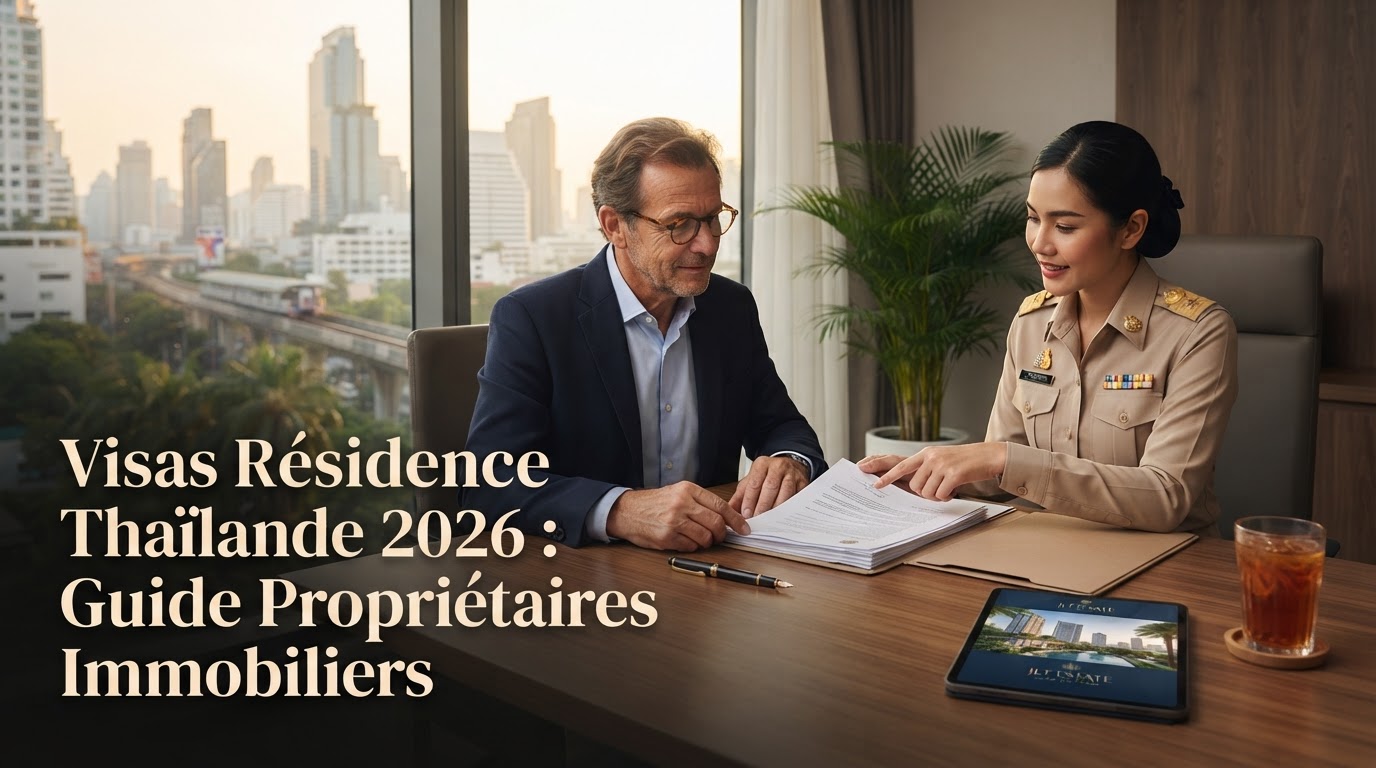
Thailand Resident Visas 2026: A Guide for Real Estate Owners
Discover which visa to choose in 2026 for living in Thailand after purchasing real estate: LTR Visa, Elite, Retirement, and Business visas decoded by experts.
JLT Estate
Phuket & Krabi Real Estate Expertise
Introduction
Investing in real estate in the Land of Smiles represents the culmination of a life dream or a fantastic way to diversify assets for many international investors. Between the pristine beaches of Phuket, the spectacular cliffs of Krabi, and the wild tranquility of Phang Nga, the appeal of Thai real estate remains as strong as ever. Recent data from the Real Estate Information Center (REIC) and the Bank of Thailand confirm a robust recovery in foreign investment, driven by an idyllic lifestyle and attractive rental yields.
However, a crucial question arises immediately after acquiring a foreign freehold condominium or a leasehold villa: how can you stay there legally without the constraints of short-term tourist visas? Contrary to popular belief, becoming a property owner in Thailand does not automatically grant permanent residency.
In 2026, immigration authorities and the Board of Investment (BOI) have structured a clear visa ecosystem designed to meet the diverse profiles of investors, digital nomads, and retirees. This comprehensive guide breaks down the long-term residency options available and their direct links to your real estate investment.
Does buying property grant the right to a visa?
A fundamental distinction must be made from the outset: purchasing real estate in Thailand does not automatically confer a right of residence. There is no direct "golden visa" granted simply upon presenting a title deed (Chanote), as seen in some European or Caribbean programs.
Nevertheless, the value of your local real estate assets can be a decisive lever for meeting the financial requirements demanded by certain state-managed prestige programs, particularly the Long-Term Resident (LTR) visa.
The traditional 10 million THB investment visa
Historically, Thailand has offered an investment visa (Non-Immigrant IB) renewable annually for any foreigner injecting at least 10 million Thai baht (approximately 260,000 to 280,000 euros depending on exchange rates) into the local economy. This amount can consist of:
- ◆Purchasing a new condominium in direct freehold.
- ◆A fixed-term deposit in a Thai state bank.
- ◆Purchasing Thai government bonds.
Although this option still exists, modern investors now prefer the facilities offered by the LTR or Privilege programs.
The LTR (Long-Term Resident) visa: The premium option for investors
Launched under the aegis of the Thailand Board of Investment (BOI), the LTR visa has established itself as the premier "golden ticket" for long-term settlement. Valid for 10 years (in the form of an initial 5-year permit, renewable for an additional 5 years), it grants unparalleled benefits:
- ◆Annual residency notification to immigration (replacing the tedious 90-day report).
- ◆Access to "Fast Track" lanes at international airports in Bangkok, Phuket, and Chiang Mai.
- ◆Permission to include a spouse and dependent children under 20.
- ◆Eligibility for a Digital Work Permit under certain conditions.
For real estate owners, two categories of the LTR visa are particularly relevant in 2026:
1. "Wealthy Global Citizen" category
This category targets high-net-worth individuals with global assets of at least $1 million USD. The investor must inject at least $500,000 USD into Thailand. Your real estate investments (condominiums held in your own name) are explicitly counted toward this $500,000 quota, alongside government bonds or investments in local businesses.
2. "Wealthy Pensioner" category
Reserved for individuals aged 50 or older:
- ◆If your annual pension or passive income reaches at least $80,000 USD, no local capital investment is required.
- ◆If your annual passive income is between $40,000 and $80,000 USD, you must make an additional investment of at least $250,000 USD in Thailand. Purchasing real estate perfectly meets this investment requirement.
| LTR Profile | Income / Asset Requirements | Real Estate / Local Investment Required |
|---|---|---|
| Wealthy Global Citizen | $1,000,000 USD net assets | $500,000 USD (eligible real estate) |
| Wealthy Pensioner (Tier 1) | $80,000 USD/year passive income | None |
| Wealthy Pensioner (Tier 2) | $40k to $80k USD/year passive income | $250,000 USD (eligible real estate) |
The Thailand Privilege Visa (formerly Elite Visa): Absolute peace of mind
If you do not wish to justify complex income levels, asset declarations, or extensive medical insurance coverage to the BOI, the Thailand Privilege program (operated by the Thailand Privilege Card Company, a subsidiary of the Tourism Authority of Thailand - TAT) is the most flexible formula for owners of second homes in Phuket or Krabi.
Thailand Privilege features
- ◆Stay durations: Modular packages of 5, 10, 15, or 20 years.
- ◆Administrative simplicity: No monthly income requirement, no extensive medical examination, and no minimum age.
- ◆VIP benefits: Personalized greeting upon arrival, limousine transfers to your villa, assistance with administrative procedures, and access to airport lounges.
- ◆Membership cost: Packages start from 900,000 THB for the 5-year option (Gold Membership), with progressive tiers for Platinum, Diamond, and Reserve formulas.
This visa is ideal if you are buying a luxury villa in Phang Nga or a penthouse in Bang Tao to spend a few winter months each year without worrying about visa extension formalities.
The Retirement Visa (Non-Immigrant O and O-A): The classic solution
For people aged 50 and over wishing to live full-time in their property, the traditional retirement visa remains the most common and economical path.
Financial requirements for the Retirement Visa
Two options allow you to meet the criteria of Thai immigration services:
- ◆Bank deposit: Lock a minimum amount of 800,000 THB (approximately 21,000 to 22,000 euros) in a Thai bank account in the applicant's name (the balance must be present 2 months before the application and maintained for 3 months after for the Non-O visa).
- ◆Monthly income: Prove a monthly retirement pension of at least 65,000 THB, certified by your embassy or official bank statements.
- ◆Health insurance: Mandatory for the Non-Immigrant O-A visa applied for from your home country, covering medical and hospitalization costs.
Note: Retirement status prohibits any paid professional activity on Thai soil, but allows you to freely enjoy your property.
The Business Visa (Non-B) and company creation: Special cases
Some investors acquire real estate (notably individual villas) by holding shares in a Thai Limited Company.
Although Thai law strictly regulates land ownership by foreign nationals (Thai shareholders must own at least 51% of the share capital with legitimate funds), an active business structure can justify the issuance of a Non-Immigrant B visa accompanied by a Work Permit.
Regulatory requirements
To sponsor a foreign work permit, the Thai company must generally:
- ◆Justify a paid-up share capital of at least 2 million baht per work permit.
- ◆Employ at least four Thai employees registered for social security.
- ◆Demonstrate genuine commercial activity (hospitality, rental management, consulting, etc.).
Using a "dormant" company solely created to hold a house and request a visa is formally prohibited by the authorities. For absolute legal certainty, prioritize structures validated by specialized business attorneys.
Mandatory administrative procedures for every owner
Regardless of the residency status chosen in 2026, owning property in Thailand involves complying with two unavoidable administrative rules:
- ◆The TM.30 declaration: Every property owner or manager is obligated to notify the arrival and place of residence of any foreign national within 24 hours of moving in. If you reside in your own apartment, you must register your address on the immigration bureau's digital platform.
- ◆The 90-day report: Except for LTR visa holders (who only declare their presence once a year), every foreign resident staying more than 90 consecutive days in the territory must confirm their current address to immigration, online or at a local office.
Summary comparison of 2026 visa options
| Visa Type | Validity Duration | Cost / Investment Required | Work Permit Possible? | Ideal For... |
|---|---|---|---|---|
| LTR Visa | 10 years | $250k–$500k investments + income | Yes (Digital Work Permit) | Asset investors, wealthy retirees |
| Thailand Privilege | 5 to 20 years | From 900,000 THB | No | Second homes, flexible stays, no paperwork |
| Non-Immigrant O/O-A | 1 yr (renewable) | 800k THB bank or 65k THB/mo | No | Retirees 50+ |
| Non-Immigrant B | 1 yr (renewable) | Company structure (2M THB capital / 4 staff) | Yes | Entrepreneurs and local business managers |
Conclusion and tailored support
Linking the acquisition of a property in Phuket, Phang Nga, or Krabi to obtaining the appropriate residence visa requires a global strategic vision. Each profile presents specific opportunities: leveraging your acquisition to secure a 10-year LTR visa, opting for the exclusive comfort of a Thailand Privilege pass, or simply organizing your retirement in the tropics.
To navigate the Thai legal and tax frameworks with peace of mind, enlist the help of confirmed specialists. JLT Estate, your premier French-speaking real estate agency in southern Thailand, guides you through every step: from the rigorous selection of the best new or resale properties to connecting you with our trusted legal partners to obtain your residence visa.
Do you have an acquisition or relocation project in Thailand in 2026? Contact the JLT Estate team today for a personalized consultation and make your project a reality.